Network Spinal Care in Austin
A gentle, hands-on approach to helping your nervous system let go of tension
Family Wellness Center — Dr. James Lee, D.C.
The Short Version
Network Spinal — many people still know it by its original name, Network Spinal Analysis, or simply “NSA” — is a light-touch chiropractic method. There is no twisting, no popping, and no sudden force. Instead, Dr. Lee makes very precise, feather-light contacts at a handful of specific spots along your spine, and then waits. Your body does the rest.
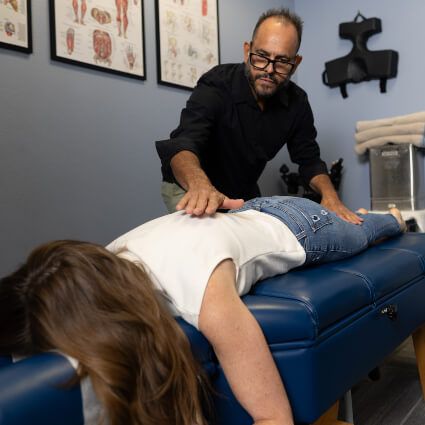
Most people are surprised the first time. You lie on a padded table, usually face down, fully clothed. The contacts are so gentle that some patients wonder whether anything is happening at all. Then, often within a few visits, something does: your breathing shifts on its own, and a soft, rolling motion travels up and down your back without you consciously making it happen. That movement is the whole point of the approach.
Why Light Touch Instead of a Traditional Adjustment
Traditional chiropractic works from the outside in. The doctor finds a joint that isn’t moving well and applies a quick, controlled thrust to restore motion. It’s effective, and Dr. Lee uses conventional techniques when they’re the right fit.
Network Spinal comes at things from the opposite direction — from the inside out. Rather than pushing a bone into a new position, the goal is to give your brain a piece of information it can act on.
Think of your nervous system as both the wiring and the operating system of your body. It runs your posture, muscle tension, breathing, digestion, and stress response — all of it, mostly without your input. When you’ve been under sustained strain — a car accident, years at a desk, an old injury, chronic stress, grief, or simply a body that’s been bracing for a long time — your nervous system adapts by holding you in a guarded posture. Muscles stay half-contracted. Breathing gets shallow and stays high in the chest. Range of motion shrinks. Over months and years, that guarding stops feeling like guarding and just starts feeling like you.
A nervous system stuck in defense mode isn’t spending much energy on repair, digestion, or recovery.
Who Developed It
Network Spinal was created by Dr. Donald “Donny” Epstein, a chiropractor from Brooklyn and a graduate of New York Chiropractic College. He began developing the approach in the 1980s, originally calling it Network Chiropractic, drawing on several existing traditions — including Logan Basic and upper cervical chiropractic — while adding observations of his own.
The central observation came around 1986. Dr. Epstein proposed that long-term physical and emotional stress creates abnormal tension in the spinal cord and the connective-tissue sleeve surrounding it, and that this tension interferes with how well the brain and body communicate. Relieving that tension, he argued, would do more for a person than repeatedly forcing individual joints to move.
Dr. Epstein went on to write The 12 Stages of Healing and Healing Myths, Healing Magic, served as president of the Association for Network Care, and taught on the postgraduate faculty at Sherman College. He has trained thousands of chiropractors internationally and continues to teach from his base in Boulder, Colorado.
What Happens During a Visit
Assessment. Dr. Lee checks your spine by hand, looking for where you’re holding tension and — just as importantly — where you’re not. He’s looking for what practitioners call spinal gateways: small areas that are relatively free of tension and have some slack available. These tend to cluster near the top of the neck and near the tailbone, where the protective covering of the spinal cord anchors to bone. Gateways aren’t fixed addresses — they move, and Dr. Lee reassesses several times within a single session.
Contact. He applies a light, sustained touch at the gateway, with careful attention to angle, depth, and timing. That’s it. There’s no force to brace against, which is part of why the approach suits people who are in too much pain for a conventional adjustment, or who simply don’t want to be popped.
Response. Over a series of visits, most patients begin to develop two distinctive patterns of movement:
Sessions are short, generally ten to thirty minutes, and you’re often on the table alongside other patients in a shared, quiet space. Many people describe a session as deeply restful. Some notice their posture change. Some feel emotion surface — a sigh, tears, a wave of relief — which is normal and nothing to be concerned about. The body and the emotions aren’t separate systems.
Somato Respiratory Integration: The Part You Do at Home
Alongside the table work, Dr. Lee teaches a set of simple exercises called Somato Respiratory Integration, or SRI. These combine focused breathing, light self-touch, and gentle movement, and they’re organized around the twelve stages described in Dr. Epstein’s work.
SRI matters because it keeps the process from being something done to you. Between visits, these exercises help you notice what your body is actually doing and give you a way to work with tension yourself, rather than waiting for the next appointment. Patients who practice them consistently generally progress faster.
The Three Levels of Care
Network Spinal care is usually described in three broad stages. People move through them at very different speeds, and progress isn’t a straight line.
- Level One — Discover. The goal here is connection: helping your brain locate tension it had stopped noticing. Most people report better energy, easier breathing, less pain and stiffness, and better sleep during this stage.
- Level Two — Transform. As the guarding releases, that energy becomes available for something else. Patients in this stage often describe more mental clarity, steadier follow-through, and a sense that they’re reacting to life less and choosing more.
- Level Three — Awaken. The nervous system develops more flexible strategies for handling stress in the first place. People commonly describe a shift in perspective — more resilience, a stronger sense of purpose, and more attention to the people and things around them.
How Often You’ll Come In — and Why It Matters
This is the part we want to be upfront about from day one, because it’s the single biggest factor in whether you get results.
That’s a real commitment, and we don’t ask for it lightly. Here’s the reasoning.
Network Spinal isn’t a repair — it’s a learning process. You’re not having something fixed on the table; your nervous system is learning a new pattern, and nervous systems learn the same way you learned to drive or play an instrument: through consistent, spaced repetition. One session gives your brain a piece of information. It takes many sessions, close enough together, for that information to stop being a novelty and start becoming the way your body operates by default.
Twice weekly during those first 10 to 12 weeks is what allows the work to actually take hold and download into your nervous system rather than fading between visits. Come in sporadically and you’ll likely feel pleasant after each session while your body quietly reverts to its old holding pattern in between — which is the most common reason people conclude Network Spinal “didn’t work” for them. Come in consistently and the changes start to stack.
Once that foundation is established and your waves are developing reliably, the frequency steps down to about once a week. From there, Dr. Lee will reassess with you and adjust the plan based on what your spine is actually doing — not a fixed formula.
Being Straight With You About the Research
We want to be honest here, because you deserve that.
The largest study of Network Spinal to date was a retrospective survey by Blanks, Schuster, and Dobson, published in 1997 in the Journal of Vertebral Subluxation Research. It gathered self-reported outcomes from more than 2,800 patients across many practices. Roughly three-quarters reported improvement in every category measured — physical wellbeing, emotional wellbeing, stress response, quality of life, and overall life enjoyment — with gains that continued to build over time rather than plateauing. Later work by Dr. Epstein and colleagues, including a 2009 paper in the Journal of Alternative and Complementary Medicine, has explored the theoretical model behind the approach.
Here’s the important caveat: that survey asked people how they felt, after the fact, without a comparison group. That’s a meaningful signal, and it matches what we see in the office every day — but it isn’t the same as a randomized controlled trial. The research base for Network Spinal is still developing. Anyone who tells you it has been definitively proven to treat a specific disease is overstating the evidence, and we won’t do that.
What we can tell you plainly: it’s gentle, it’s low-risk, patients consistently report feeling better, and you’ll know within a reasonable number of visits whether it’s working for you.
Common Questions
Do I have to make the wave happen?
How often do I need to come in?
What if I can’t make two visits a week right now?
Can it help my specific symptom?
Ready to Find Out How Your Spine Is Doing?
Dr. James Lee has helped patients at Family Wellness Center reconnect with how their bodies are meant to feel. If you’re curious whether Network Spinal is a fit for you, the first step is a straightforward conversation and an evaluation.
Call our office or book online to schedule your consultation.
This page is for general education and is not medical advice. Network Spinal care is provided as wellness care and is not a diagnosis or treatment for any specific disease or condition. Please consult your physician regarding any medical concern, and before making changes to any prescribed treatment.
